Stories That Make You Different
Beyond the Battlefield: The Forgotten Soldiers of World War II and the Story of Baker Battery
By Melvin E. Edwards | Media Well Done, LLC
History remembers the generals who commanded armies, the battles that changed the course of wars, and the political leaders who shaped the world. But who remembers the men who loaded the guns, repaired the trucks, maintained the communications lines, prepared the meals, and carried out the countless ordinary tasks that made victory possible?
More than eight decades after World War II, that question remains important.
The Allied victory in Europe was an extraordinary military achievement, accomplished through the combined efforts of millions of service members. Yet the historical record often emphasizes major battles, famous commanders, and sweeping strategic decisions.
Less frequently do we encounter the experiences of the ordinary soldiers whose work sustained those campaigns.
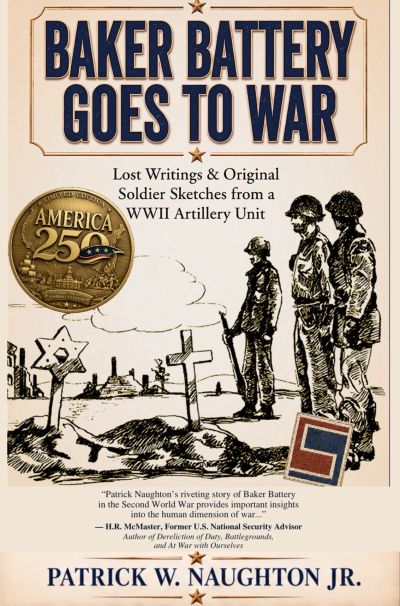
Baker Battery Goes to War, by Patrick W. Naughton Jr., offers an opportunity to recover part of that history.
Drawing upon a remarkable collection of wartime writings and illustrations, the book preserves the experiences of American artillerymen and the soldiers who served alongside them during World War II.
Their stories remind us that wars are not fought by famous names alone.
The 69th Infantry Division and the War in Europe
The U.S. Army's 69th Infantry Division, known as the Fighting 69th, participated in the final campaigns against Nazi Germany.
Activated during World War II, the division eventually deployed to Europe and entered combat in 1945.
Its soldiers operated in a rapidly changing battlefield environment as Allied forces advanced into Germany and the Third Reich approached collapse.
The division is particularly remembered for its historic meeting with Soviet forces near Torgau on the Elbe River in April 1945.
That encounter became one of the symbolic moments of the war's final weeks in Europe.
But major historical milestones tell only part of the story.
For the individual American soldier, the campaign was experienced through movement orders, unfamiliar terrain, uncertain conditions, exhausting routines, and the ever-present possibility of danger.
The experience of an artillery unit was shaped not only by military objectives but also by the relationships among the men who depended upon one another.
Understanding those experiences requires looking beyond the official summaries of military operations.
It requires listening to the soldiers themselves.
The Men Behind the Guns
An army functions through an enormous network of interdependent responsibilities.
Some soldiers occupy the positions most visible in wartime photographs and historical accounts. Others perform essential work that is rarely celebrated.
Consider the mechanic responsible for keeping a vehicle running during a difficult movement.
Or the wireman working to maintain communications between positions.
Or the cook attempting to provide a hot meal to exhausted soldiers far from home.
Or the clerk whose records helped a military organization function amid the disorder of war.
These men were not peripheral to the military mission.
They were part of the mission.
Their contributions also remind us that courage can take many forms.
Not every act of wartime service occurs during a dramatic confrontation with the enemy.
Sometimes courage means continuing to perform a necessary duty under dangerous conditions, despite fatigue, uncertainty, and fear.
The daily work of soldiers deserves a place alongside the accounts of celebrated battles and commanders.
That understanding is central to Baker Battery Goes to War.
A Remarkable Discovery: History Preserved in a Binder
Some of the most valuable historical records survive not because an institution carefully preserved them, but because an ordinary person saved something that might otherwise have been discarded.
The origins of Baker Battery Goes to War illustrate that possibility.
Patrick W. Naughton Jr. encountered a binder at an estate sale containing writings associated with a World War II artillery unit, accompanied by illustrations created by Glatfelter.
What might have appeared to be a collection of old papers held something far more significant: a record of wartime experiences preserved through the voices and observations of men who had lived them.
The discovery created an opportunity to bring those accounts to a new generation of readers.
It also raises a larger question about historical preservation.
How many firsthand accounts of World War II remain in attics, closets, estate collections, and family archives?
How many letters, journals, sketches, photographs, and unit histories have been lost because their significance was not immediately recognized?
Every such document has the potential to deepen our understanding of the past.
Official military records can establish where a unit served and what missions it carried out.
Personal writings can reveal something different: how soldiers experienced those events and how they understood their own service.
Both kinds of evidence matter.
Together, they offer a more complete historical picture.
Preserving the Legacy of the Greatest Generation
The phrase Greatest Generation is often associated with Americans who endured the Great Depression and served during World War II.
Their military service has been commemorated in museums, memorials, documentaries, and countless books.
Yet preserving that legacy requires more than celebrating victory.
It also requires protecting the evidence of how the war was experienced.
That means preserving the contributions of soldiers whose names never became famous.
The men who operated artillery pieces, repaired equipment, maintained communications, treated the wounded, and performed the routine work of military service were essential participants in a defining chapter of American history.
Their experiences deserve to survive beyond the lifetimes of those who knew them.
Recovered personal records offer one way to accomplish that.
When carefully preserved and presented, they allow future generations to encounter the past through voices that might otherwise have fallen silent.
Why Baker Battery Goes to War Deserves Attention
Patrick W. Naughton Jr.'s book belongs to an important tradition of military history: the preservation of accounts written by or associated with the men who served.
Its significance lies not simply in documenting another American military unit during World War II.
It lies in the opportunity to recover a perspective that broad historical narratives can overlook.
The book invites readers to consider how an artillery unit operated, how ordinary soldiers experienced wartime service, and why seemingly modest personal records can possess lasting historical value.
For military historians, it offers material connected to American artillery service and the European campaign.
For veterans and military families, it provides an opportunity to recognize the kinds of service that rarely receive public attention.
For students and educators, it demonstrates the value of firsthand documents in understanding historical events.
And for general readers, it offers a reminder that the history of war is ultimately a history of people.
The Responsibility to Remember
There is a difference between remembering a war and preserving the experiences of those who fought it.
Remembering a war often means recalling its most famous battles, commanders, and turning points.
Preserving its human history requires something more.
It requires attention to the overlooked soldier, the forgotten document, the surviving sketch, and the ordinary detail that reveals how people lived through extraordinary events.
The men of Baker Battery were part of a generation whose collective service helped shape the modern world.
Their individual experiences are worthy of remembrance.
A soldier does not have to become famous to deserve a place in history.
Sometimes the most important stories are the ones we nearly lost.
Discover Baker Battery Goes to War
Written by Patrick W. Naughton Jr. and published by Media Well Done, LLC, Baker Battery Goes to War brings recovered World War II writings and illustrations to a new generation of readers.
The book is especially relevant to readers interested in:
- World War II and the European Theater
- The U.S. Army's 69th Infantry Division
- American field artillery and military unit histories
- Firsthand accounts of military service
- The daily lives of ordinary American soldiers
- Veterans' history and the preservation of wartime records
Explore the book and Media Well Done's publishing program: https://mediawelldonellc.com/books
About the author: Patrick W. Naughton Jr. is the author of Baker Battery Goes to War, a work developed from a recovered collection of World War II writings and illustrations.
About the publisher: Media Well Done, LLC, founded by award-winning journalist, author, and publisher Melvin E. Edwards, is an independent publishing company committed to illuminating stories that official histories leave in the shadows.