Stories That Make You Different

Pre-Order Your Copy Today
Some History Isn't Lost. It's Waiting to Be Found.
This link allows you to place your order now and be one of the first to receive the book when it is released.
Media Well Done's Growing Catalog

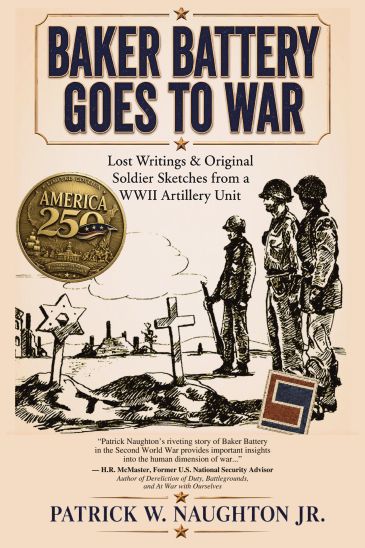
Baker Battery Goes to War
Patrick W. Naughton, Jr.
Hardcover
$26.99

Baker Battery Goes to War- Patrick W. Naughton Jr.
An Estate Sale. A Black Binder. A Generation’s Voice.
Among the books and papers at a Northern Virginia estate sale, Patrick W. Naughton Jr. spotted a worn black binder.
Inside was a piece of World War II history that had survived for decades: the writings and original sketches of the soldiers of Baker Battery, 881st Field Artillery Battalion, 69th Infantry Division.
The men had put their experiences on paper near the end of the war. They left behind their own account of the life they had shared—the work, the hardship, the humor, and the losses. Now their words were sitting among belongings offered for sale.
Naughton recognized what he was holding. That discovery became Baker Battery Goes to War.
Through firsthand writings, poignant poems, and original soldier artwork, the book brings readers close to the people who kept an artillery battery fighting. Alongside the guns are the cooks, mechanics, wiremen, clerks, and medics whose work made the unit possible. Together, their contributions preserve something an official record can struggle to convey: what it felt like to belong to that group of men, in that place, at that moment in history.
For readers with a parent or grandparent who served, these pages may open a door to conversations that never happened. For younger generations, they offer a chance to encounter World War II through the words of people who lived it. And for anyone who has ever sorted through a loved one’s photographs, letters, or belongings, the discovery raises a question that reaches far beyond military history:
How much of a life can disappear when no one recognizes what has been left behind?
Vietnam veteran and retired Brigadier General Clarence M. Agena calls the book “a valuable and deeply human contribution to the history of the King of Battle.”
Former Marine platoon commander J. C. O’Neil writes that its details and poems brought back memories of “American bravery and resilience in combat.”
A binder survived. Someone opened it. Now these soldiers have readers they could never have imagined.
November 11, 2026
Military History · Media Well Done, LLC · 2026
Library of Congress Control Number: 2026947283
ISBN (Hardcover): 979-8-9969330-1-3

Preorder the hardcover -- $26.99
Nuremberg, Mississippi - Melvin E. Edwards
May 1, 2026
Literary Fiction · Media Well Done, LLC · 2026
Library of Congress Control Number: 2026938443
ISBN (Hardcover): 978-1-80764-269-3
ISBN (Paperback): 978-1-80764-268-6
In Mississippi, a Black man named Henry Logan is arrested for being out after dark in the fictional sundown town of Greenville, MS. What follows is not a single act of violence or hatred — it is something more difficult to name, and far harder to escape.
Nuremberg, Mississippi is a work of literary fiction set in the mid-twentieth-century American South, tracing the procedural machinery through which legal systems deliver harm without ever announcing themselves as harmful. Logan's encounter with Myrtle County's courts unfolds across fractional chapters — increments of bureaucratic time that mirror the experience of living inside a system designed to exhaust, confuse, and defeat.
The novel draws its title from a precise historical argument: that the architects of the Nuremberg Laws studied American Jim Crow statutes as a model for codified racial hierarchy. German theologian Dietrich Bonhoeffer observed that moral failure most often disguises itself as discipline, professionalism, and obedience. Nuremberg, Mississippi asks what that observation looks like when applied not to Nazi Germany, but to an American courthouse on an ordinary afternoon.
Written with the procedural authority of a legal document and the moral weight of witness testimony, this debut novel belongs to the tradition of Colson Whitehead's The Nickel Boys and Richard Wright's Native Son — books that refuse to let legality stand in for justice.
Award Submission Update:
Nuremberg, Mississippi has now been submitted for consideration for the Pulitzer Prize, the PEN/America Faulkner Award and the PEN/America Open Book Award, continuing its push for recognition among major literary and cultural institutions.
Other Awards Submissions for 'Nuremberg, Mississippi' - Independent Publisher Book Awards, Best Indie Book Awards, Anisfield-Wolf, Readers' Favorite, Booky, PenCraft.

A Family Heirloom Edition
The Names They Kept is a definitive Black Texas family chronicle tracing the author’s maternal and paternal lines from slavery, Reconstruction, and Jim Crow to public service, memory, and inheritance.